
The Brave Bookshelf Dispatch
Books, brave conversations, author news, and one internet thing I’m probably overthinking.
Hi bookish friends, 📚
Can we talk about AI for a second?
I know. I know.
The minute someone says “AI,” half the room gets nervous, the other half gets defensive, and the writers in the corner start clutching their manuscripts like someone just threatened their firstborn.
So grab your coffee, tea, or emotional support bookmark.
It’s time for another Brave Bookshelf Dispatch.
📁 THE BRAVE BOOKSHELF CASE FILE
Recently, I read a Fortune article about the AI writing debate, and it made a comparison I can’t stop thinking about.

Apparently, people were worried about WRITING itself way back in ancient Greece.
Yes. Writing.
As in, the thing most of us now consider very normal unless we’re staring at a blank page and questioning all our life choices.
The article explains that in Plato’s Phaedrus, Socrates tells a story about writing being offered as a tool for memory and wisdom. But King Thamus wasn’t buying it. He believed writing would make people forgetful because they would rely on written marks instead of their own memory. In other words, writing could become a crutch. It could make people look wise without actually understanding what they were talking about.
Sound familiar?
That’s pretty much one of the big fears around AI right now.
Will it help us think?
Or will it think for us?
Will it help writers organize their thoughts, plan their posts, and keep up with the business side of publishing?
Or will it create work that sounds polished but has no heart, no lived experience, no weird little human spark?
And honestly?
I get both sides.
I don’t think AI should replace authors.
Full stop.
A book needs a human heart behind it. It needs lived experience, grief, joy, awkward middle school memories, strange family dynamics, bad decisions, coffee-fueled panic, and whatever odd little brain moment makes someone ask, “What if a support app became a kill list?”
That’s not something I want handed over to a machine.
But I also think AI can be a wonderful tool when used responsibly.
And responsibly means responsibly.
I do not think AI should be used to steal from other authors.
I do not think it should plagiarize someone’s work, copy another writer’s voice, or scrape creative work so someone else can pass it off as their own.
That’s not creativity.
That’s stealing.
And honestly, it’s lazy.
There is a huge difference between using AI to help organize your messy thoughts and using it to take from someone else’s hard work.
Know the limits. Know the risks. Don’t pretend bad choices are harmless just because the tool is available.
For me, AI is not writing my books.
It’s not creating the emotional guts of my stories.
It’s not replacing my voice, my characters, my themes, or the scenes I wrestle with until I want to toss my laptop into the nearest lake.
But it does help me with the business side of being an author.
Newsletters.
Social media.
Planning.
Brainstorming.
Organizing the fifty-seven thoughts running around my head like caffeinated squirrels.
And here’s the truth: I don’t have a staff.
I don’t have assistants.
I don’t have a writing assistant.
I don’t have an agent.
And to be honest, I’m not even sure I want one. Agents take a percentage, and I often wonder how helpful they really are unless they’re getting you into one of the big publishing houses. And even then, do we need that path the same way we used to?
Maybe. Maybe not.
That’s a whole other newsletter and possibly a snack-fueled rant for another day.
But as an indie-minded, small press author, book reviewer, podcaster, blogger, mom, ESL teacher, and Behavior Technician, I have to be honest about what I can realistically do.
AI helps me save my writing energy for my books.
Because I’m not one of those writers who wakes up with perfect sentences floating above my head like magical butterflies.
I need help.
I need notes.
I need reminders.
I need something to help me shape the business stuff so I can keep my creative brain for the stories.
And I don’t think that makes me less of a writer.
I think it makes me a writer living in 2026 who is trying to keep up.
📚 In Conclusion: Write Responsibly 😁
The Greek argument about writing made me laugh a little, but it also made me pause.
Because maybe every new tool scares us at first.

Writing scared people.
The printing press scared people.
The internet scared people.
Social media scared people.
Now AI scares people.
And sometimes, the fear is valid. Tools can be misused. They can make us lazy. They can help people fake knowledge they don’t have. They can blur lines that should stay visible.
But tools can also help us.
A notebook doesn’t make me less of a thinker because I write down my ideas.
Spellcheck doesn’t make me less of a writer because it catches the word I misspelled three different ways.
A thesaurus doesn’t steal my voice because I forgot the word I wanted and my brain decided to offer “thingy” instead.
So maybe the real question is not, “Is AI good or bad?”
Maybe the better question is:
Are we using it as a tool, or are we letting it become the author?
For me, that line matters.
There are also ways to use AI more carefully.
You can create private bots.
You can adjust privacy settings.
You can choose what you share and what you don’t.
You can use it as a helper instead of treating it like a ghostwriter hiding in your laptop.
At least, that’s how I see it.
I know not everyone agrees, and that’s okay. This is one of those conversations where I think we need more honesty and less yelling into the void.
Because authors are tired.
Publishers are nervous.
Readers are curious.
And technology keeps changing whether we’re ready or not.
That’s actually one of the reasons I’m drawn to writing thrillers like The Kill App. Technology can help us. It can connect us. It can protect us.
But it can also scare the pants off us when it gets into the wrong hands.
Very on brand for me, apparently.
So here’s my take:
AI should not replace authors.
AI should not steal from authors.
But it can support authors.
It can help us keep up with the parts of publishing that feel impossible when we’re already writing books, reviewing books, recording podcasts, posting online, answering emails, and trying to remember if we moved the laundry from the washer to the dryer.
Spoiler: I probably did not.
What I’m Reading 📚🌴🔪
This week, I’m sharing How the Other Half Dies by P.C. Roscoe, a steamy murder mystery full of rich-kid drama, secrets, scandals, and one tropical vacation that goes very, very wrong.
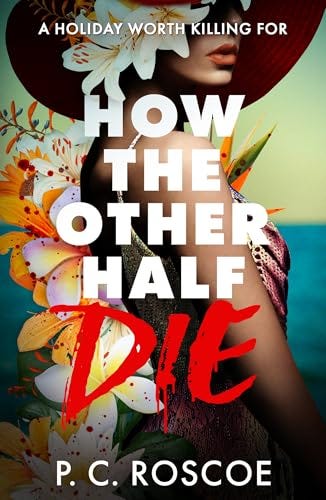
The story follows Avery, who returns to ultra-exclusive Mokani Island — her so-called happy place — and brings along her college roommate, Nora. Sounds dreamy, right?
Private island.
Rich friends.
Parties.
Ocean views.
Except the vibes are off almost immediately.
Avery’s ex is still hanging around.
Her best friend is acting strange.
A new staff member is watching her a little too closely.
And Nora keeps asking questions no one wants answered.
Which, of course, means everyone is hiding something.
And on an island packed with money, jealousy, family drama, and secrets?
Someone is bound to end up dead.
I gave this one 4 stars.
Overall, I really enjoyed the secrets, lies, twists, and messy vacation-gone-wrong drama. This is the kind of thriller where everyone feels suspicious, everyone has baggage, and paradise starts feeling more like a trap with better lighting.
My only hang-up was that a few moments didn’t fully work for me. Since some of these characters come from very wealthy, powerful families, I expected them to be a little more aware of what was happening in their parents’ lives — especially when arguments and business stress were happening around them.
Avery, for example, seemed surprisingly unaware of why her parents were so stressed, even though she’s supposed to take over the family business someday. Her panic over cheating on a college test felt small compared to everything else happening around her.
That could have been intentional, with certain information held back to make the twists more dramatic, but in a few places it pulled me out of the story.
Still, the rest of the secrets, tension, murder mystery, and island drama worked really well for me.
If you like thrillers with messy friendships, rich-family scandals, love triangles, tropical storms, and people making very questionable choices in beautiful places, this one is worth checking out.
You can read my full review and get the book here:

🎤 NEW ON THE BRAVE BOOKSHELF
In case you missed it, here’s what’s new:
📚 Latest Review:

✍️ Coming Soon: More book reviews, brave conversations, spooky thoughts, and probably more proof that I cannot hear one strange internet story without turning it into a thriller.
You can catch up here:
My website on Substack is always free, and if you’re on this newsletter, you’re already subscribed, so just click on the link above. But if you would like to support me, you can subscribe to a paid subscription of $5 to $50 and cancel/unsubscribe at anytime. No pressure. 😁
📅 AUTHOR EVENTS & BOOKISH NEWS
Here’s what’s coming up:
📍 Funky Ferndale Art Fair — September 26, 2026 10:00 am - 3:30 pm
I will be in Ferndale, Michigan, signing and selling my book “Ask the Girl” with my fellow SCBWI.org Michigan authors, and I would love for you to stop by and say hello! You can also discover and explore local art, food, and entertainment!

And behind the scenes, I’m currently working on:
🔪 The Kill App revisions
👻 More spooky bookish content
🎶 Trying not to turn viral music fame into a murder mystery
📚 Reading books that emotionally attack me and then expecting me to function like a normal person
Bold of them.
💬 YOUR TURN
I’m curious where you fall on this.
Do you use AI?
Would you use it for newsletters, social media, research, brainstorming, or planning?
Or are you firmly in the “no thank you, I’ve seen this movie and the robots do not behave” camp?
Reply and tell me. I’d really love to know.
Warmly,
Kim
Author | Book Reviewer | Writing Cheerleader
The Brave Bookshelf with Kim Bartosch
P.S. Bonus question: If AI showed up in a YA thriller, would it be the villain, the sidekick, or the suspicious character who says, “Trust me” way too early?